
From River Families to Flying Rivers: Highlights from the Amsterdam Screening of Our Blue World
As the final screenings of the year approach, Our Blue World returned to Amsterdam with an evening that was anything but quiet. At Pakhuis de Zwijger, the film set the stage for a charged and deeply human conversation on what it means to care for water at a time when the world feels increasingly off balance.
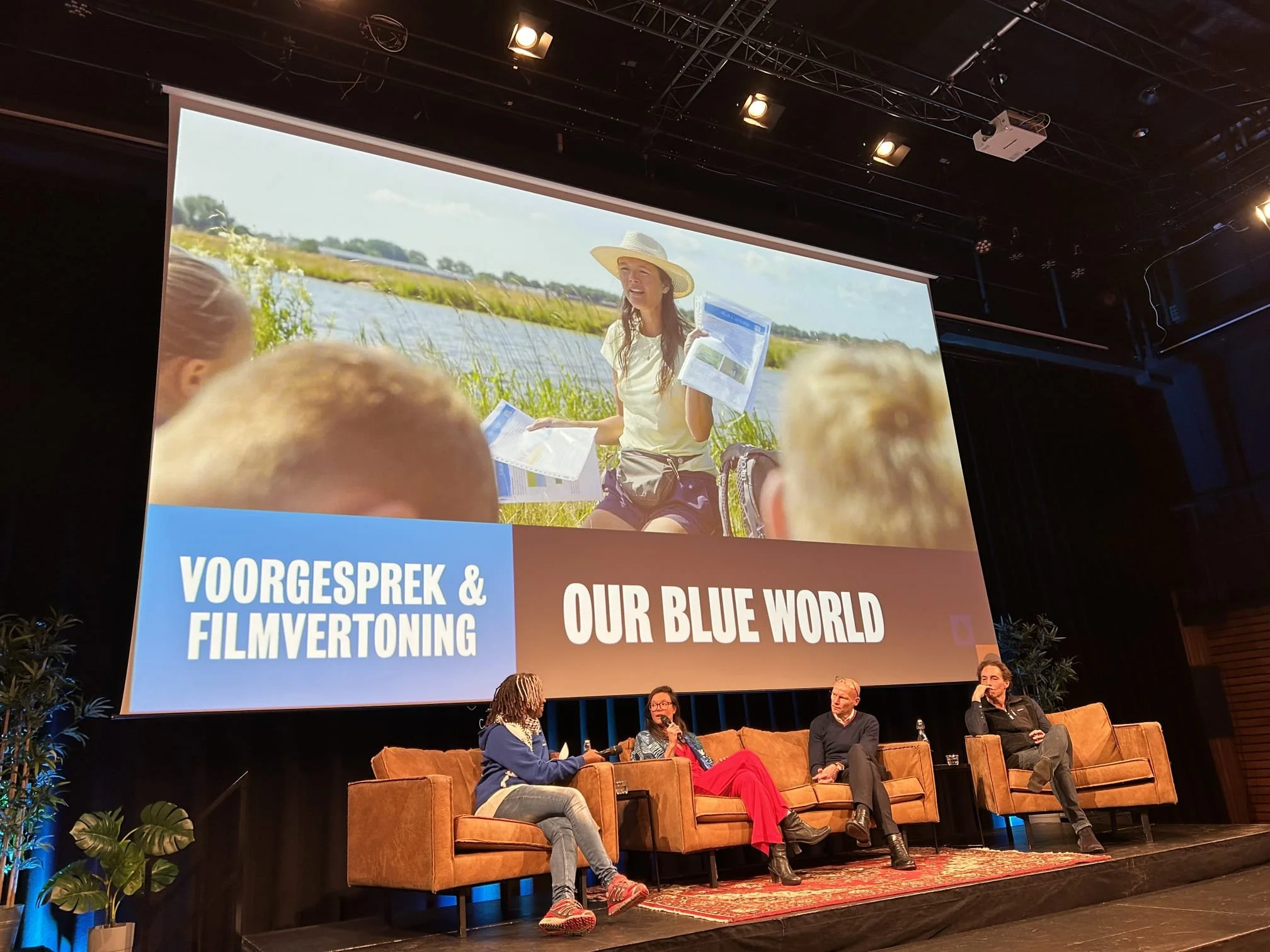
The panel brought together three voices who each approach water from a different angle, yet converge on the same truth: if we continue to treat water as an afterthought, we will continue to undermine our own future.
Li An Phoa, founder of Drinkable Rivers, opened with a principle so simple it feels radical: a river should be clean enough to drink from.
Henk Ovink, Executive Director of the Global Commission on the Economics of Water and former UN Special Envoy for International Water Affairs for the Kingdom of the Netherlands, laid out the scale of the crisis with clarity and urgency.
Frodo van Oostveen, CEO of World Waternet, grounded the discussion in the practice of everyday stewardship, both in Amsterdam and in communities around the world.
“We are all part of a river family.” – Li An Phoa
Li An has built her life’s work around a seemingly simple question: What would change if we expected our rivers to be drinkable again?
For her, water is not an external system but an extension of our own bodies. The oldest water inside us is only four days old, she explained, and we exchange it constantly with the living world. Rivers, people, plants, animals — everything is circulating in one connected system. That, to her, is a river family.
She emphasised that drinkable rivers are not a nostalgic idea or an idealistic dream. They are a direction, a compass. They show us what healthy water systems look like and how communities can orient themselves around them.
Her work turns abstraction into experience. Through long-distance river walks, maps of river systems, and work with local communities, she brings people into direct contact with the water that shapes their lives. “If we can bring ourselves back into relationship with water,” she said, “we become better caretakers of it.”
“Water is failing because we have failed to value it.” – Henk Ovink
If Li An brings the relational, Ovink brings the systemic — and the uncompromising honesty.
Ovink reminded the audience that safe drinking water and sanitation, so ordinary in Amsterdam, are inaccessible to billions. Two billion people do not have safe water. Four billion lack safe sanitation. And water infrastructure, he noted, is routinely targeted in conflicts, leaving communities without the most basic human necessity.
He challenged the comfortable idea that water is cheap because it is abundant. In reality, water is cheap because we refuse to value it. And the consequences are everywhere: polluted rivers, depleted groundwater, collapsing ecosystems, and risk accumulating across every sector of society.
He introduced the concept of flying rivers — the moisture that evaporates from forests and wetlands and produces rainfall across continents. When forests are destroyed, flying rivers disappear, and entire regions lose their rain. Water scarcity, in other words, is deeply tied to land use.
For Ovink, the issue is not a lack of solutions. It is a lack of will. He spoke bluntly about the failures of industry, the insufficiency of current policies, and the refusal of many governments — including wealthy ones — to confront the true cost of water degradation. He argued for a shift where harmful practices must first prove they aren’t destructive before they are permitted. The burden should not be on society to clean up after polluters.
His message cut through every part of the discussion: until we value water properly, economically and culturally, we will continue to fail it.
“Stewardship begins at home.” – Frodo van Oostveen
Amid the urgency voiced by Ovink and the vision brought by Li An, Frodo grounded the conversation in the practice of water management where it happens each day: locally.
As CEO of World Waternet, Frodo works with Amsterdam’s water institutions while also supporting public water utilities in Kenya, Jordan, Burkina Faso and elsewhere. For him, the real work lies in strengthening local capacity — not replacing it.
He spoke about colleagues who swim in the Amstel year-round, not as a stunt, but as a lived relationship with the water they care for. He explained that people around the world often assume the Dutch must deeply value water, given their long history of managing it. But Frodo noted that even in the Netherlands, awareness is uneven. Many residents don’t realise how much water they use, or how fragile the systems behind the tap (and sewerage) truly are.
His reminder was simple and pragmatic: stewardship begins with knowing your water, being curious and noticing its condition, understanding your local river or canal or water cycle, observing when something is wrong. The big system only works when communities, utilities and authorities stay connected to the small system.
The conversation closed with a reminder that the river outside the building, the Amstel, is not separate from the Amazon, the Congo, or the rain that falls in Europe. Flying rivers connect everything. River families include us all.
And if we are part of the river, then the river’s future is also our own.